Robert DeSanto
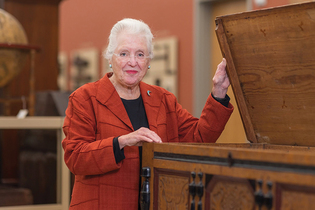
Patricia Kane ’87PhD examines a colonial chest with drawers from Wethersfield, Connecticut. She spent 58 years with Yale’s American decorative arts collection.
View full image
Patricia E. Kane ’87PhD, one of the nation’s foremost curators of American decorative arts and a longstanding figure in Yale’s arts community, died on July 8 at Yale New Haven Hospital at age 82 after a brief illness. She is survived by her husband, W. Scott Braznell ’67ArtA, an independent scholar of silver.
Kane came to the Yale University Art Gallery in 1968 and spent the subsequent 58 years overseeing its collection of American decorative arts. (Her title changed many times; since 2002, she had been the Friends of American Arts Curator of American Decorative Arts.) Born in Bridgeport, Connecticut, Kane attended Chatham College (now Chatham University) in Pittsburgh and then received her MA from the Winterthur Program in Early American Material Culture at the University of Delaware. Under the mentorship of Charles Montgomery and then Jules Prown, she received a PhD from Yale in 1987; her dissertation focused on two early Massachusetts silversmiths.
Kane had an encyclopedic knowledge of American decorative arts and an enduring curiosity about new areas of study. She authored or contributed to numerous books that have become key resources in the field. Her final exhibition and publication was Art and Industry in Early America: Rhode Island Furniture, 1650–1830 (2016), which was accompanied by an online database, the Rhode Island Furniture Archive.
She oversaw three complete reinstallations of the museum’s decorative arts galleries and the relocation of the furniture collection from a basement on York Street to the Leslie P. and George H. Hume American Furniture Study Center at Yale West Campus. She also acquired for Yale the Anne T. and Robert M. Bass Sack Family Archive, the records of Israel Sack Inc., a leading dealer of Americana.
Kane believed in connoisseurship and relished teaching others how to evaluate objects. “Looking at objects is a very important part of being a connoisseur,” she said in 2023, “but being able to touch them, to get a sense of surfaces, what their weight is, how they feel in the hand is also an important part of connoisseurship.
Certainly, when you are working with three-dimensional objects, being able to examine them first by the hand and with your eyes is a two-part process that is critical and very illuminating.”
She mentored generations of Yale students and fellows and helped collectors, scholars, and dealers cultivate their critical abilities. “Pat was one of my most influential mentors during my time as a graduate student,” President Maurie McInnis ’96PhD told YaleNews. “I started working for her during my very first week at Yale, and she served as one of my PhD examiners and sat on my dissertation committee. She taught me how to find meaning in seemingly ordinary objects, encouraged me to question assumptions that might lead my research astray, and instilled in me how important it is to trust the process of deep investigation and careful looking to uncover more profound knowledge.” Kane demonstrated excellence herself, which in turn, inspired those around her.
 loading


 Print
Print Email
Email