loading
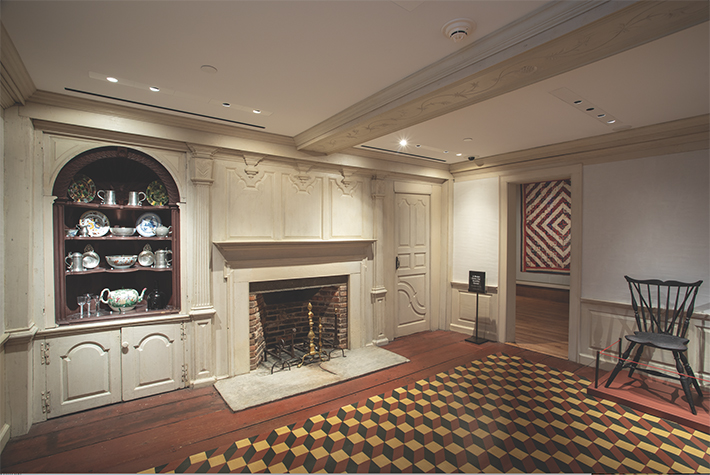
Arts & CultureObject Lesson: If these walls could talkAn 18th-century Connecticut parlor, reconstructed in the Art Gallery. Author Patricia E. Kane ’87PhD, longtime curator of American decorative arts at Yale University Art Gallery, died on July 8. Her colleague John Stuart Gordon contributed to this article after her death. A room from the Rowley House, now installed in the Yale University Art Gallery, is an exceptional example of the architectural style known as Connecticut River Valley Baroque. The woodwork originally adorned the parlor of a building that still stands today in Hebron, Connecticut. Since the 19th century, various stories have been affixed to the house: It has been dated as early as the 1740s, has been associated with the Youngs, Rowley, or Gillette families, and there were even rumors that Hessian soldiers were imprisoned there during the Revolutionary War and carved the decorative details out of boredom. In the course of restoring the room at Yale between 2007 and 2012, researchers consulted archival sources and performed dendrochronology (the dating of wood by analyzing the growth rings) to uncover its real history. The land the house was built on was first owned by the Youngs family, who helped settle the town in the early 18th century. In 1751 Abijah Rowley married Hannah Youngs, and following her death the next year he continued to live on his in-laws’ property, even after he remarried in 1755. He and his second wife, Hannah Curtis, acquired full ownership of the land by 1768. Analysis showed the timber used for the woodwork was cut down in 1769 and probably installed the following year. During the 1920s, patriotic groups began documenting early American architecture that they worried was under threat of demolition. In 1927, a member of the Connecticut chapter of the Colonial Dames of America brought the room to the attention of the New Haven–based restoration architect J. Frederick Kelly ’12BFA, who in turn contacted Yale. Francis P. Garvan, Class of 1897, had just begun giving his significant collection of American decorative arts to Yale in honor of his wife, Mabel Brady Garvan, and agreed to fund the purchase of the room in 1930. The intent was to install the room in an expanded Gallery of Fine Arts, but the Great Depression got in the way, and plans for the building came to a stop. The woodwork was put in storage, where it remained until 2007, when its conservation came up again. Three years later, in 2010, the woodwork was moved to Yale West Campus when space became available there. Gallery staff members cleaned the grime accumulated during 70 years in storage from the surfaces of the woodwork. Testing of the paint layers revealed the room had seven to nine layers of white paint, some of which needed stabilization. The firm of Fallon and Wilkinson was hired to erect the room temporarily at Yale West Campus in anticipation of its move to Street Hall as part of the Art Gallery expansion and renovation of 2012. The pilasters flanking the fireplace, with their capitals carved with floral ornaments, and the three panels above the fireplace with their opposed c-scroll motifs framing rotund drops, mark this room as an excellent example of late Baroque domestic architecture. The floral carving on the summer beam—the structural member extending from the fireplace wall to the opposite wall—is unique in colonial New England architecture, but the flowering vine shares its botanical theme with other architectural elements found in the Connecticut River Valley, particularly doorways. The motif also appears on textiles worked by women during this period. The interior of the cupboard capped by shell and leafage carving was later painted deep maroon, but was originally bright vermillion. In the early 19th century, the paneling was updated to make the fireplace opening smaller and to add the mantle shelf. The wide pine floorboards are original, and at some point the floor was painted red around the perimeter of the room but was left unpainted at the center where a carpet would have been. To mask this discrepancy, the Gallery had a floorcloth created in the tumbling block pattern known to have been used in New England in the 19th century. Museums often stage their period rooms with recreated textiles, light fixtures, and other details of everyday life. Here, the room is interpreted as a work of architecture to be enjoyed for its robust details and surviving surfaces. The few featured objects speak to the type of goods a prosperous rural family may have owned, such as Windsor and York chairs, imported ceramics, and locally made pewter. Visitors to the Art Gallery can admire the quality of the woodwork or imagine the world of Hannah and Abijah Rowley.
|

|

 Print
Print Email
Email