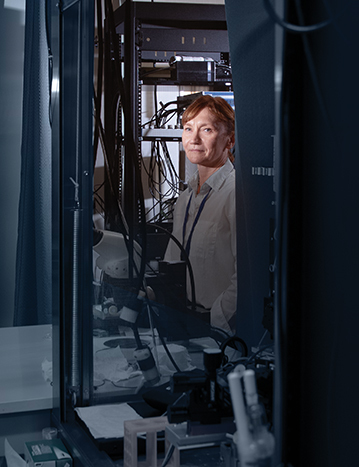
Dana Smith
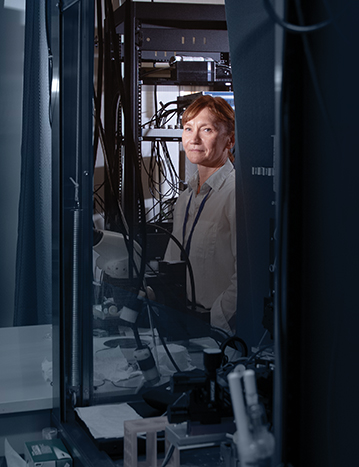
Professor Elena Gracheva and her team study thermoregulation and other secrets
of animal hibernation.
View full image

Dana Smith
Professor Elena Gracheva and her team study thermoregulation and other secrets
of animal hibernation.
View full image
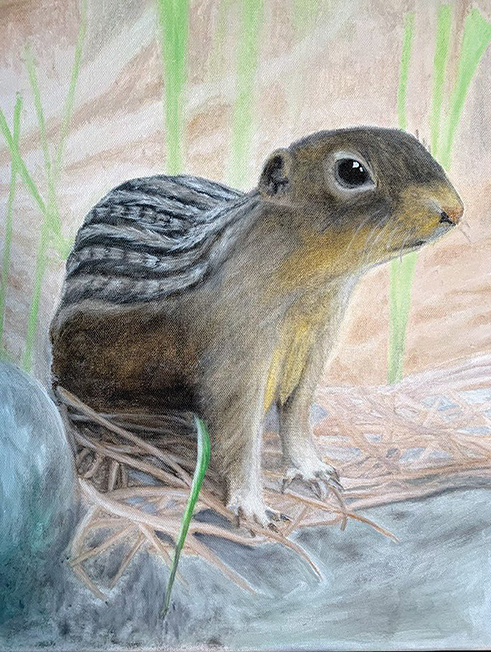
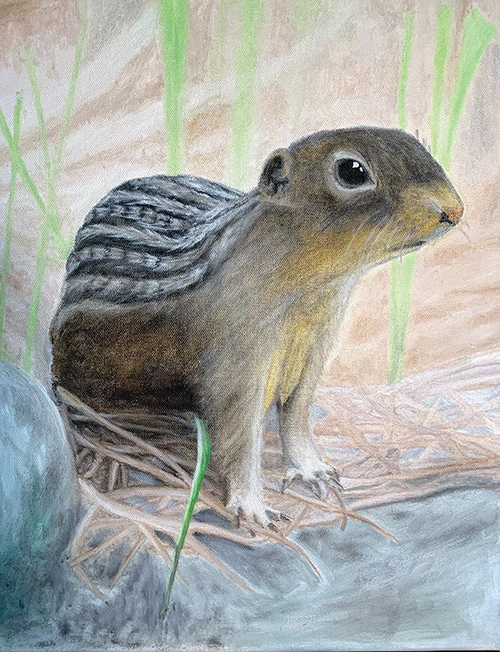
Elena Gracheva’s father Oleg Grachov, a physicist, paints portraits of ground squirrels like the one above for her students after they defend their doctoral theses. Gracheva insists that he read the papers first.
View full image
Elena Gracheva’s father Oleg Grachov, a physicist, paints portraits of ground squirrels like the one above for her students after they defend their doctoral theses. Gracheva insists that he read the papers first.
View full image
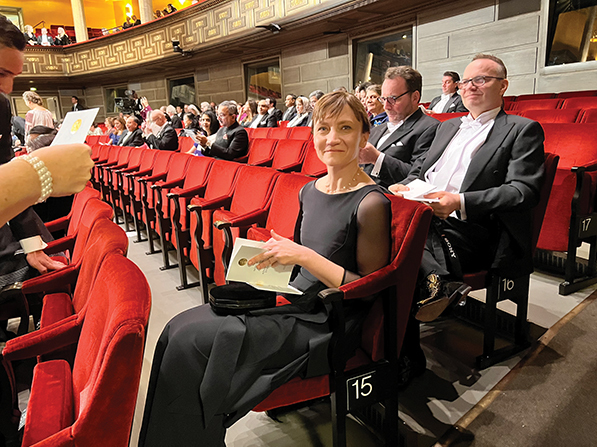
Courtesy Elena Gracheva
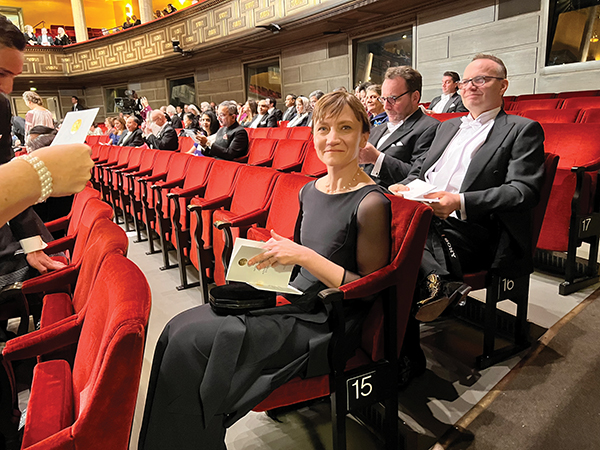
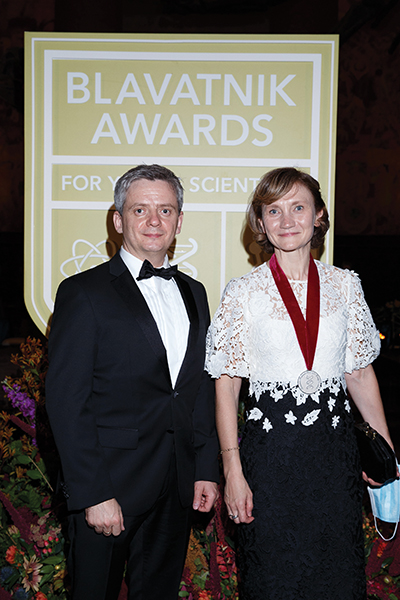
Gracheva at the 2022 Nobel Ceremony and at the 2021 Blavatnik award ceremony.
View full image

Courtesy Elena Gracheva
Gracheva at the 2022 Nobel Ceremony and at the 2021 Blavatnik award ceremony.
View full image
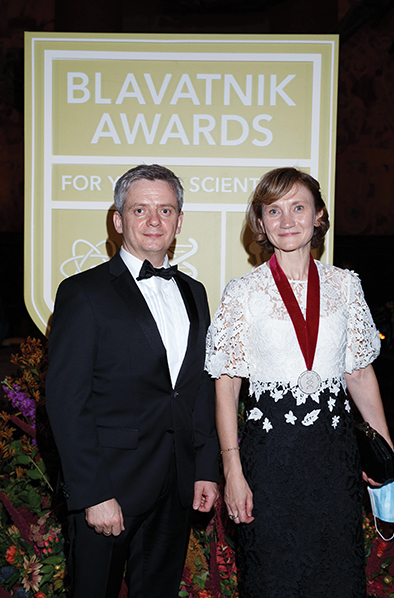
Courtesy Eena Gracheva
Gracheva at the 2021 Blavatnik award ceremony with husband Slav Bagriantsev, director of a lab adjacent to hers at the medical school.
View full image

Courtesy Eena Gracheva
Gracheva at the 2021 Blavatnik award ceremony with husband Slav Bagriantsev, director of a lab adjacent to hers at the medical school.
View full image
In the basement of the Yale School of Medicine is a large colony of ground squirrels that, for upwards of seven months a year, remain motionless, curled up like furry balls, each in their own fluff-filled habitat. They don’t eat or drink. Their heart rates have plummeted. They barely breathe, maybe a few gasps a minute. Their body temperatures have dropped to near freezing. Their brains have flatlined.
They look like they are sleeping, but they’re not. A sleeping brain is far more active. Nor are they awake. They are hibernating, a state closer to death than to life. When they awaken, they will mate, eat, make babies, and hibernate again.
These tiny rodents spend more time in seeming nonexistence than consciousness. It’s a remarkable state of being that has long fascinated neurophysiologist Elena Gracheva.
Gracheva, the Dorys McConnell Duberg Professor of Neuroscience and of Cellular & Molecular Physiology, directs a lab at the medical school that has already uncovered secrets of hibernation that have defied scientific explanation for generations. She’s confident she and her team of graduate and postdoctoral researchers are on the verge of solving more physiological puzzles. Not only that, she believes findings from these little creatures have huge implications for human health, too.
For instance, Gracheva has collaborated with a cardiovascular researcher who is investigating an experimental technique called “suspended animation” to cool bodies into a hibernation-like state to conduct surgery. She has shared her biological findings with transplant doctors who are trying to find ways to extend the life of organs for transplantation. In what sounds more like science fiction than reality, space scientists are tapping into hibernation research so astronauts might be able to sustain long missions into outer space with little food or water.
Still, Gracheva’s passion is grounded in basic biology. She marvels at the physiological achievements of her tiny laboratory subjects. “Their bodies get as cold as the inside of a refrigerator,” yet they awaken refreshed and rewired, she says. “Can you imagine that? It’s incredible!” Consider this: If a human were to emerge that quickly from such a deep state of near nonexistence, our bodies would implode. We’d die from the molecular chaos triggered by the rapid arousal. Yet emerging evidence suggests that when hibernators awaken—sometimes within minutes—they may even be healthier than before. Their brains and guts have been rebooted. A stunning feat.
Her rodents—known as thirteen-lined ground squirrels or Ictidomys tridecemlineatus—look more like chipmunks than the typical tree squirrels scampering on the campus outside her lab. They’re also called “striped gophers,” and they seem to enjoy the low-cut grass terrain of cemeteries and golf courses. (Think 1980’s Caddyshack, where Bill Murray relentlessly stalks a gopher, albeit one without stripes.)
Gracheva has always had a soft spot for animals, and unusual ones in particular. As a child in Moscow, her parents had a subscription to Young Naturalist, a monthly nature magazine with pictures and stories. She devoured and reread each issue. Though she was sent to intensive ballet school starting at the age of five, within a few years her dreams of going professional were quashed. “My teacher told my parents my butt was too big, and I should try something else,” she says with a laugh.
Gracheva switched to a specialized school for math and physics. (Her father was a physicist, and her mother was a mechanical engineer.) She excelled, thanks to her father, who insisted she work with him every night on homework designed for college students. She was around eleven years old when the evening sessions started. “He’s very serious. He still reads all my papers and criticizes them and tells me how to approach things differently,” she says with another laugh.
Gracheva met her future husband and scientific collaborator, Slav Bagriantsev, on the first day of Moscow State University. (He directs an adjacent lab as Yale’s Dorys McConnell Duberg Professor of Cellular and Molecular Physiology.) Back then, they had every class together. “He was getting As in math because of me,” she says. Bagriantsev agrees.
After graduation, Bagriantsev left Russia for a doctorate at the University of Illinois–Chicago and urged her to follow. “He called me one day and said, ‘I don’t think we are just friends,’ and asked me to marry him. I said, ‘let me think about it.’” After she joined him in the United States, they wed in 2002, and she conducted her doctoral research in neuroscience at UI–Chicago. Gracheva’s thesis focused on signals between neurons in C. elegans, a microscopic roundworm.
For her postdoctoral work, Gracheva wanted to think “outside the box.” (C. elegans is a typical research tool.) In 2008, she urged David Julius to give her a spot in his lab at the University of California, San Francisco. He had discovered the molecular receptor TRPV1, which detects temperature—landmark research that led to his 2021 Nobel Prize in Physiology or Medicine. Julius recalls at their first meeting thinking Gracheva was a bright young scientist with determination and moxie. Gracheva remembers that he looked at her and said, “you look like the kind of person who can work with snakes.”
And with that, he sent her and another young scientist to the National Natural Toxins Research Center in Kingsville, Texas. Their job: to dissect and collect rattlesnake neurons.
The two women arrived at the windowless reptile center and were greeted by an “extremely welcoming” director. Immediately, Gracheva heard the ch-ch-ch of rattles. Ever so carefully, they accomplished their chore and shipped the cells via overnight FedEx to California.
In the utter darkness, rattlesnakes can detect prey from up to a meter away. Scientists knew this spectacular ability had to do with the snake’s “pit organ,” a tiny cavity between their nostrils and eyes covered by a thin membrane—like a miniature drumhead except laced with nerve endings. Gracheva wanted to uncover the precise molecular mechanisms.
The rattlesnake neurons provided some evidence, but not enough. She convinced Julius that she needed to expand her research to boa constrictors and pythons, larger snakes with more of these specialized organs. Plus, since they are evolutionarily older, they provide hints to how these sensory adaptations developed over time. “I told him they might bite, but they won’t kill you.”
The first snake, a boa, arrived in a pillowcase. Gracheva put the reptile package on a lab bench while grabbing lunch and returned to a snakeless sack with a hole. A fellow investigator spotted the escapee; she and Julius retrieved it.
Gracheva’s studies elucidated how pit organs sense subtle differences in temperature emitted by the prey.
Apparently, Julius harbored no lingering ill will over the snake that nearly bolted. Years later, in 2021, Gracheva was invited to attend Julius’s Nobel Prize ceremony in Sweden. “It was like a fairy tale,” she says.
As director of her own laboratory at Yale since 2012, Gracheva has continued to investigate sensory receptors, but she has returned to her first love: the hibernators.
Hibernation is really two parts: torpor and interbout arousal. Torpor is the deathlike state when heart and breathing rates plunge and brain waves are barely detected. Interbout arousals are fleeting periods of semi-awakeness. For a day or two every few weeks (the timing varies), the body temperatures and metabolism of the squirrels she studies rise to near normal. The point of interbout arousal remains a mystery. They remain in this non-torpid/not-fully-awake state for a day or two.
Gracheva estimates they sleep more than half the time, and when they aren’t sleeping, they move around in their burrow but will not seek water or food, and will refuse drinks or snacks if offered. Gracheva suspects this intermediate phase is necessary, in part, to catch up on sleep. Torpid animals, despite looking like they’re resting, might be sleep-deprived. The rodents also urinate and defecate during interbout arousal, perhaps ridding themselves of toxins accumulated during torpor.
Much of Gracheva’s research taps into the way hibernators survive and ultimately thrive under extreme conditions. In 2017, her team published the discovery that squirrels have an altered version of a protein, TRPM8, that makes them far less sensitive to the bitter cold. The protein is found in humans, too. But the human version does the opposite: It allows your body to sense the cold or know when something is painfully cold. Gracheva believes her finding that sheds light on how these animals thrive in a deep freeze could help other scientists develop new ways to preserve human organs for transplantation. These same insights might offer drugmakers new targets for treating allodynia, a disorder in which the touch of ordinary objects feels excruciatingly painful. (Allodynia is sometimes a side effect of chemotherapy.)
Gracheva’s lab also found that during hibernation, specific brain cells that normally drive hunger and thirst are less responsive to hormonal signals that drive animals to eat and drink. Now they are trying to figure out why these neurons are less responsive—clues that could help scientists develop strategies for treating anorexia or adipsia, a rare condition when people don’t feel thirsty even when dangerously dehydrated.
“That’s why I like these nonstandard animal models,” said Gracheva. “These squirrels are closer genomically to humans” and can help us understand biological pathways that mice and rat models can’t.
But lingering questions remain. For instance, the squirrels go through puberty during hibernation. Why are these little creatures defying biology? Humans who starve suppress their reproductive abilities. Her team found that male ground squirrels reach sexual maturity while hibernating. Testosterone surges and testes more than double in size right before emerging from hibernation. When squirrels awaken, they often mate even before seeking food or water.
In addition to mentoring graduate students, Gracheva and her husband launched a Sensory Physiology Club for middle and high school students in 2013. “We don’t have children, but we needed to give back to the community,” she says. The budding scientists generate their own hypotheses about taste, touch, and smell and then test them.
Gracheva’s lab is decorated with a triptych of squirrels. Her parents now live near her in Connecticut, and her father surprised her one day with a painting he had made of a thirteen-lined ground squirrel in torpor. She replied that she’d need another one in interbout arousal, and also a fully awake squirrel.
Since then, it’s become a tradition to reward her students with a personalized ground-squirrel painting after they defend their doctoral thesis. In a role reversal from her childhood days, Gracheva assigns her father homework. Before creating each painting, she insists he read the students’ papers; then he must present his design ideas, which are assessed and edited by Gracheva and her mother.
Rafael Dai Pra ’26PhD, who conducted the male squirrel puberty research, received a painting of two ground squirrels inside the chemical structure of testosterone. Madeleine Junkins ’24PhD, whose research revealed the brain suppression of thirst, has a painting of a squirrel sipping a can of Coke. “I told my father I wanted pop art,” says Gracheva. “The students get excited and tell me they want their painting,” she says, “but I tell them they have to finish their PhD first.”
What seems almost as important as their discoveries and artwork is the camaraderie Gracheva has encouraged among her students. Many of them talk about the annual summer parties at her home and the various office parties whenever there is something to celebrate, such as a student publication or an award.
Whether working with middle schoolers or postdocs, Gracheva hopes to convey the same message: If an experiment does not confirm a hypothesis, that’s not a failure. Rather, it’s an unexpected outcome. The way she sees it, “when you get something unexpected, that’s actually really exciting” and creates new paths to pursue. “It’s inevitable,” says Gracheva, “and it’s the beauty of science.”
 loading


 Print
Print Email
Email